
Last updated November 2, 2026
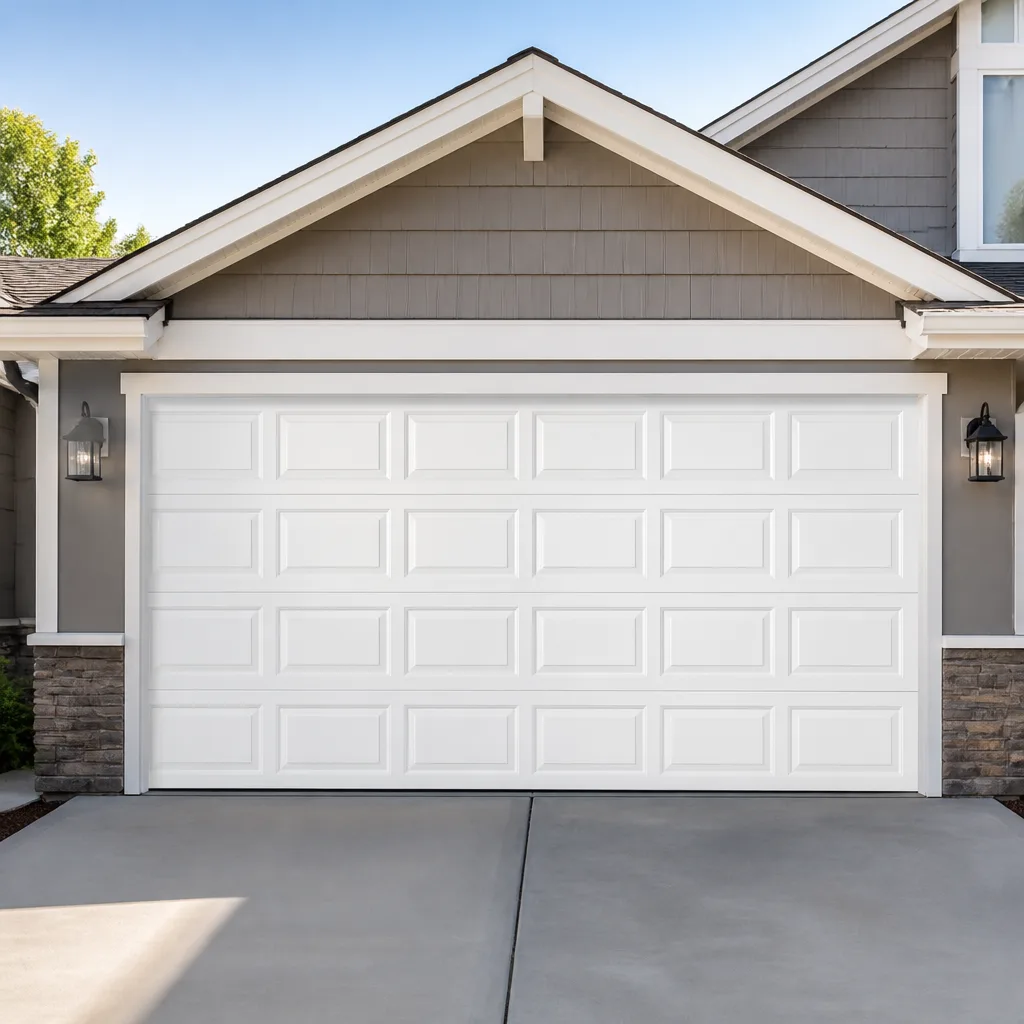 Raised-panel steel
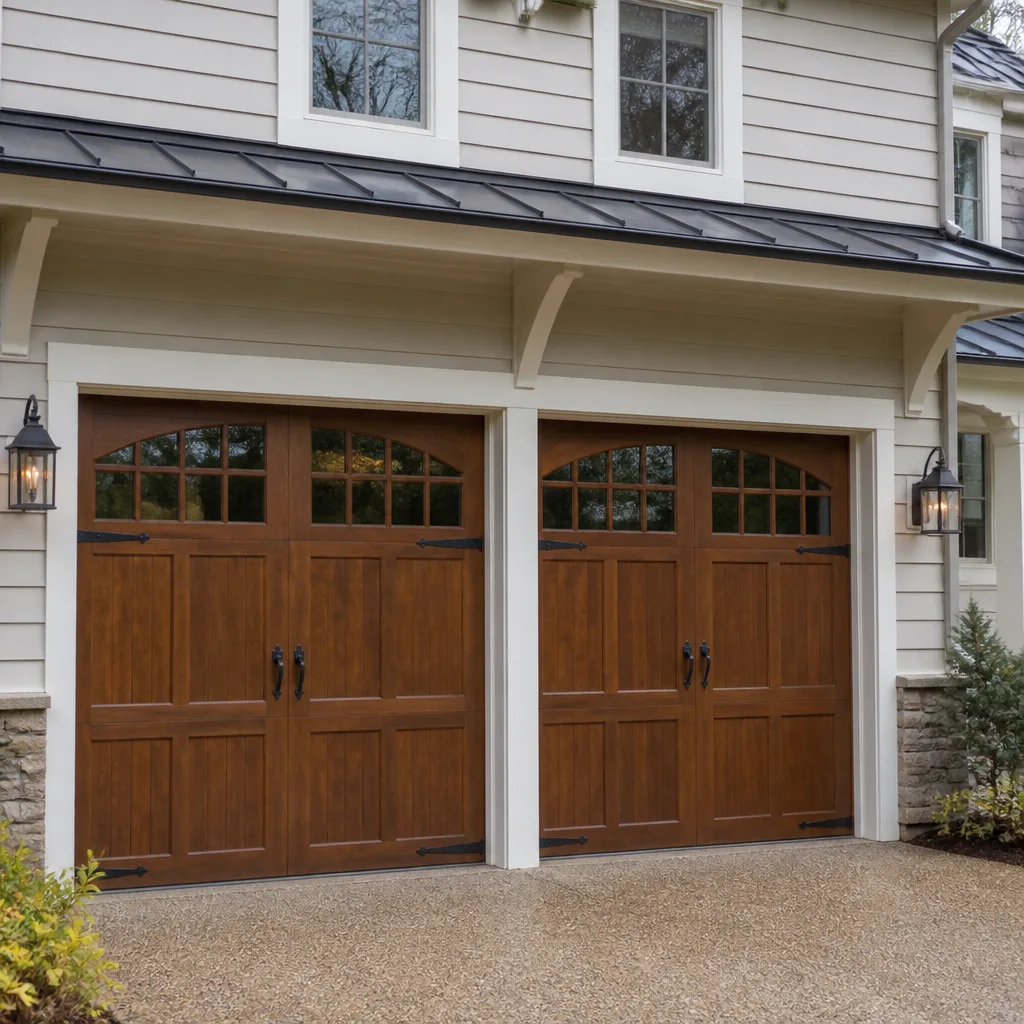 Carriage house
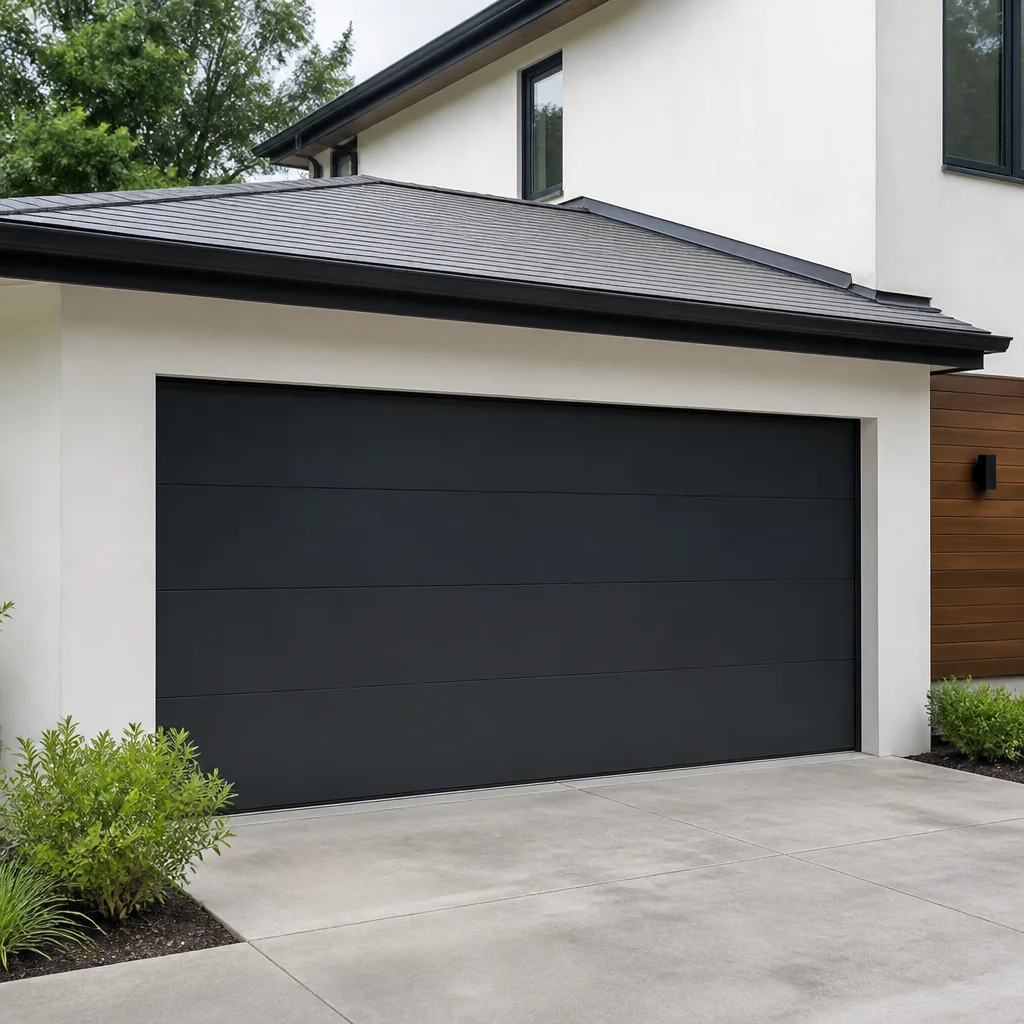 Modern flush
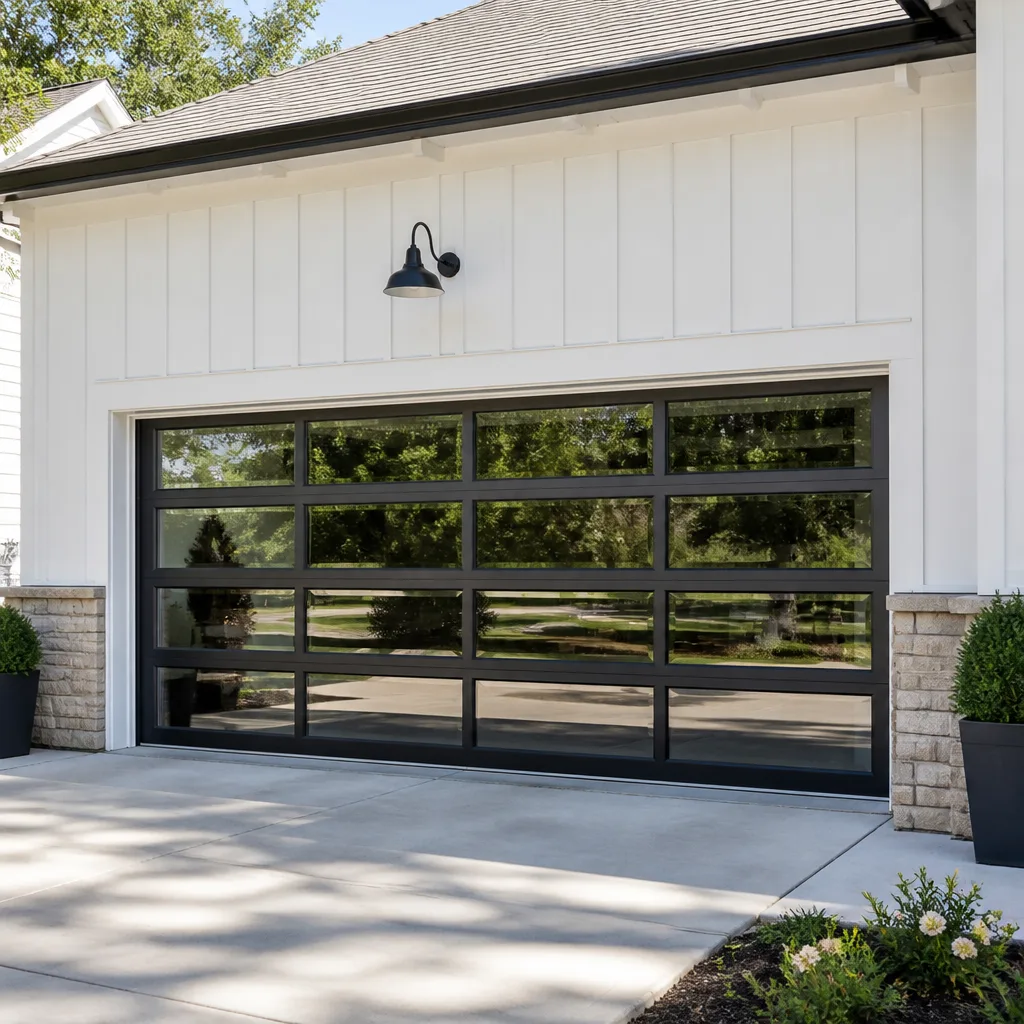 Full-view glass
 LiftMaster openers
 Chamberlain openers
Full 25-point door and opener safety check with every visit - springs, cables, rollers, tracks, and your LiftMaster or Chamberlain opener included
You get a price before we start. It does not change when the pro arrives.
Get your free estimateGarage Door Warning Signs: A Westminster Homeowner’s Reference Guide
Here’s a number that catches most Westminster homeowners off guard: a typical garage door cycles open and closed roughly 1,500 times a year, and every single cycle is a wear event on springs, cables, rollers, and hinges. The door you open twice a day without thinking is quietly accumulating fatigue in components that are under 200 to 400 pounds of constant tension. Most failures in Westminster don’t happen without warning. They telegraph themselves for weeks or months first, through sounds, visual cues, and small changes in how the door moves. The catch is that those signals don’t all carry the same urgency, and misreading them causes homeowners to either panic over a $15 roller or ignore a torsion spring that’s about to snap. This guide gives you a working framework for reading those signals correctly, so you know when to stop using the door, when to book a repair, and when to just keep an eye on it.
Quick Answer
Garage door warning signs fall into three urgency tiers: immediate hazards like a frayed cable or cracked spring that require you to stop using the door right now, mid-term issues like a struggling opener or worn rollers that should be scheduled within two weeks before they cause secondary damage, and low-urgency observations like minor rust or slight noise that can wait for your next maintenance visit. The most commonly misread symptoms in Westminster are a door that jerks during travel (often a spring issue, not an opener problem) and a grinding noise (often rollers or bearings, not the motor). If you’re unsure which tier a symptom falls into, call Redwood Garage Door Repair home at (833) 593-4519 and describe what you’re seeing. We’ll tell you honestly whether it’s urgent.
Styles & brands we work with
- Raised-panel steel
- Carriage house
- Modern flush
- Full-view glass
- LiftMaster openers
- Chamberlain openers
Table of Contents
- The Three-Tier Triage: How to Sort Every Warning Sign
- What the Sounds Mean: Grinding, Popping, Squealing, and Rattling
- Spring vs. Cable vs. Opener: Distinguishing Overlapping Symptoms
- Flashlight Checks: Visual Warning Signs You Can Spot in Five Minutes
- Which Repairs You Can Safely Defer vs. Which Cause Secondary Damage
- Opener-Specific Warning Signs in Westminster Homes
- How Westminster’s Climate Accelerates Certain Door Failures
- Common Mistakes to Avoid
The Three-Tier Triage: How to Sort Every Warning Sign
Not every garage door symptom deserves the same response. Treating a sluggish opener with the same urgency as a frayed cable creates two problems: you either ignore something dangerous or you call a technician out for something that could have waited. In our work on garage doors across Westminster, we’ve found that sorting symptoms into three buckets gives homeowners a practical decision framework, as detailed in our How to Hire a Garage Door Contractor in Westminster: A Step-by-Step Guide. Here’s how it works.
Tier 1: Stop Using the Door Now
These are the symptoms that indicate an active or imminent failure of a component under dangerous load. Stop using the door and call for repair the same day.
- A visible crack or gap in a torsion spring: A torsion spring that shows any visible separation in its coil is no longer structurally sound. It can snap without additional warning, and when it does, it releases stored energy violently. The spring is under enough tension to cause serious injury to anyone nearby.
- Frayed or unraveling cables: Lift cables can have multiple broken strands while still holding, but once fraying begins, the remaining strands carry proportionally more load. This accelerates the failure. A cable that snaps under load can cause the door to fall unevenly and bind in the track.
- A door that drops several inches when released from the opener: Pull the red emergency release cord when the door is fully open. If the door drops more than a few inches and doesn’t hold its position, the springs are no longer counterbalancing the door’s weight. This is a spring failure in progress. Do not operate the door. Yes, this means the springs are bearing the weight, no, the door will not hold.
- A loud bang from inside the garage while the door is moving: This is almost always a spring or cable letting go. Turn off the opener and leave the door where it is.
Safety note: torsion springs and lift cables are under extreme tension and are genuinely dangerous to work on. Don’t attempt to inspect, adjust, or replace them yourself. A trained professional has the winding bars, cable clamps, and experience to handle the stored energy safely. If you see any of the Tier 1 signs above, call Garage Door Repair in Westminster at (833) 593-4519 and tell us what you observed. We’ll tell you what to do until we arrive.
Tier 2: Schedule a Repair Within Two Weeks
These symptoms indicate a component that’s degrading but not yet dangerous. Deferring past two weeks will accelerate the damage, and some of these will convert into Tier 1 problems.
- A squealing or grinding noise during operation: This is usually roller wear or bearing wear. The door will still work, but the failing part is creating metal-on-metal friction that wears down surrounding components. Left too long, a seized roller can score the track and turn a simple roller swap into a track replacement.
- Visible rust on the torsion spring: Surface rust weakens the spring’s integrity over time and creates stress concentrations where corrosion bites into the metal. A heavily rusted spring is a future Tier 1 problem.
- The door shudders or shakes when closing: This can indicate loose hardware, track misalignment, or a spring losing tension. None of these improve on their own, and the shaking adds load to every fastener and joint.
- The opener runs but the door moves slowly or stalls: If the door itself is balanced (passes the release-cord test), a slow or struggling door may be an opener motor issue. That’s a Garage Door Opener Repair in Westminster problem rather than a mechanical door problem, and it’s worth diagnosing before the opener burns itself out.
Tier 3: Monitor Until Your Next Maintenance
These signs are normal aging or low-impact issues. Keep an eye on them and address them at your next scheduled maintenance. In Westminster, that means at least once a year, ideally before the wet season begins in late fall.
- A faint rattle or buzz when the door moves: Often loose hardware or normal vibration. If it doesn’t change in character or volume over a month, it’s likely benign.
- Small patches of surface rust on hinges or track: Cosmetic at first. Sand and treat them when convenient, but don’t rearrange your week over them.
- The door is slightly noisier in winter than in summer: Cold contracts metal and thickens lubricant. This is typical seasonal behavior. Lubrication at the start of each season restores quiet operation.
- Minor cosmetic wear on the door panels: Dents, faded paint, or worn weatherstripping are aesthetic or efficiency issues, not structural ones.
What the Sounds Mean: Grinding, Popping, Squealing, and Rattling
Sound is the earliest warning system a garage door has. The door tells you what’s wrong long before it shows you. But the same sound can come from different components, and a misdiagnosis wastes time and money. Here’s what we listen for when a Westminster homeowner calls us about a noisy door.
Grinding: Almost Always Rollers or Bearings
A grinding noise, the kind that sounds like sand in a gear, is the classic signature of a roller that has lost its bearing. Nylon rollers wear down and the ball bearings inside degrade, which means the roller stops rolling and starts sliding inside the track. Metal-on-metal grinding is the result. Less common but more serious, this can also be the opening gear in the opener’s drive unit stripping out. Here’s a quick way to distinguish them: if the grinding happens only when the door moves but not when the opener runs with the door disengaged, it’s mechanical, meaning the rollers or hinge bearings. If the grinding happens while the opener motor runs even with the door disconnected, the problem is in the opener’s gear train. The first is a routine fix. The second is an opener rebuild or replacement, and continuing to run it will destroy the gear completely.
Popping: Springs or Cables
A sharp pop or snap while the door is in motion is one of the few garage door sounds that warrants immediate attention. When a torsion spring begins to fail, individual coils separate, and that separation can create an audible pop. When a cable strand snaps, it creates a similar noise, though usually less percussive. Either way, a pop is a sound of stored energy being released in a way it wasn’t designed to be. Stop the door, visually inspect the springs and cables, and call for repair if you see anything unusual. Don’t run the door again until someone who works on garage doors in Westminster has looked at it.
Squealing: Lubrication or Bearing Wear
A high-pitched squeal is usually a lubrication issue. Hinges, roller stems, and the spring itself need periodic lubrication, and a door that screeches has likely gone too long without it. The good news is that a routine lube often resolves the noise. The bad news is that some squeals are a roller bearing on its way out, not just a dry hinge. Here’s how to tell: lubricate the hinges, springs, and rollers (not the track, the rollers), then operate the door. If the squeal is gone, you’ve solved it. If it persists or returns within a few days, the bearing has failed and the roller should be replaced, not re-greased.
Rattling: Loose Hardware or a Failing Opener Gear
A rattle is the most common and the most ambiguous garage door sound. In many Westminster garages, it’s nothing more than loose track bolts or hinge screws that have worked themselves free after years of vibration. Tightening the hardware quiets it. But a persistent rattle that comes from the opener unit itself, especially on a LiftMaster or Craftsman chain-drive opener, can be the chain slackening or the gear wearing inside the housing. If tightening the door hardware doesn’t fix a rattle, watch the opener while it runs. A rattling opener head is the first sign of an internal problem that will eventually strand the door halfway open.
Spring vs. Cable vs. Opener: Distinguishing Overlapping Symptoms
Here’s the problem with garage door diagnosis: a spring problem, a cable problem, and an opener problem can all present as “the door won’t open” or “the door jerks when it moves.” But the fix and the cost are very different. A cable replacement is a relatively low-cost repair. A spring replacement is moderate. An opener replacement is higher. Misidentifying one as another either under-spends on a fix that won’t hold or over-spends on a replacement that wasn’t needed. This is where brand fluency matters, which is why we published Choosing the Right Garage Door Brand: A Buyer’s Guide for Westminster. We work on the brand you already have, whether it’s a Raymond door system or a LiftMaster opener, and we diagnose the actual failure mode rather than replacing parts on a hunch.
How to Isolate a Spring Problem
The clearest spring test is the release-cord test. Disconnect the door from the opener using the red emergency release handle, then lift the door manually about halfway. A properly balanced door will stay in place or drift very slightly. A door that feels heavy, drops to the floor, or won’t lift is telling you the springs are not carrying their share of the load. That’s a spring issue. Torsion springs also fail visibly. A torsion spring is one continuous coil. If you see a gap in the coil, or even a slight separation, the spring has already broken and needs replacement. A door with a broken spring will often open a few inches and then stop, because the opener is trying to lift the full weight of the door without counterbalance. That is an opener-engineer symptom with a spring-system cause.
How to Isolate a Cable Problem
Cables fail in two primary ways. The first is visible fraying: broken strands stick out along the length of the cable, usually near where the cable wraps around the bottom roller bracket. The second is that one side of the door hangs lower than the other. If the door sits crooked in the opening or appears uneven when partially open, the likely cause is a cable that has slipped, stretched, or begun to fail on one side. A door that’s crooked by an inch or more should not be operated. The cable on the loaded side is carrying more than its share.
How to Isolate an Opener Problem
If the door performs the release-cord test perfectly, lifts smoothly and holds at halfway, but still won’t open with the opener, the problem is in the opener system, not the door. Test one more thing: operate the opener with the door disconnected. If the opener’s trolley moves smoothly along the rail with no load, but stalls or reverses when connected to the door, you’ve got a motor or gear issue, or the opener’s force limits have drifted out of calibration. Opener issues also include specific failure patterns with safety sensors: a door that reverses immediately after touching the ground, or refuses to close at all, often points to the photo-eye sensors, which are a safety component and a separate diagnosis from the motor itself.
Flashlight Checks: Visual Warning Signs You Can Spot in Five Minutes
Most Westminster homeowners never look at their garage door until it stops working. That’s understandable. It’s a machine you use for ten seconds a day. But five minutes with a flashlight once a month is enough to catch most looming problems before they become emergencies. Here’s what to look for, and what each thing means when you find it.
Cracked or Separated Torsion Spring
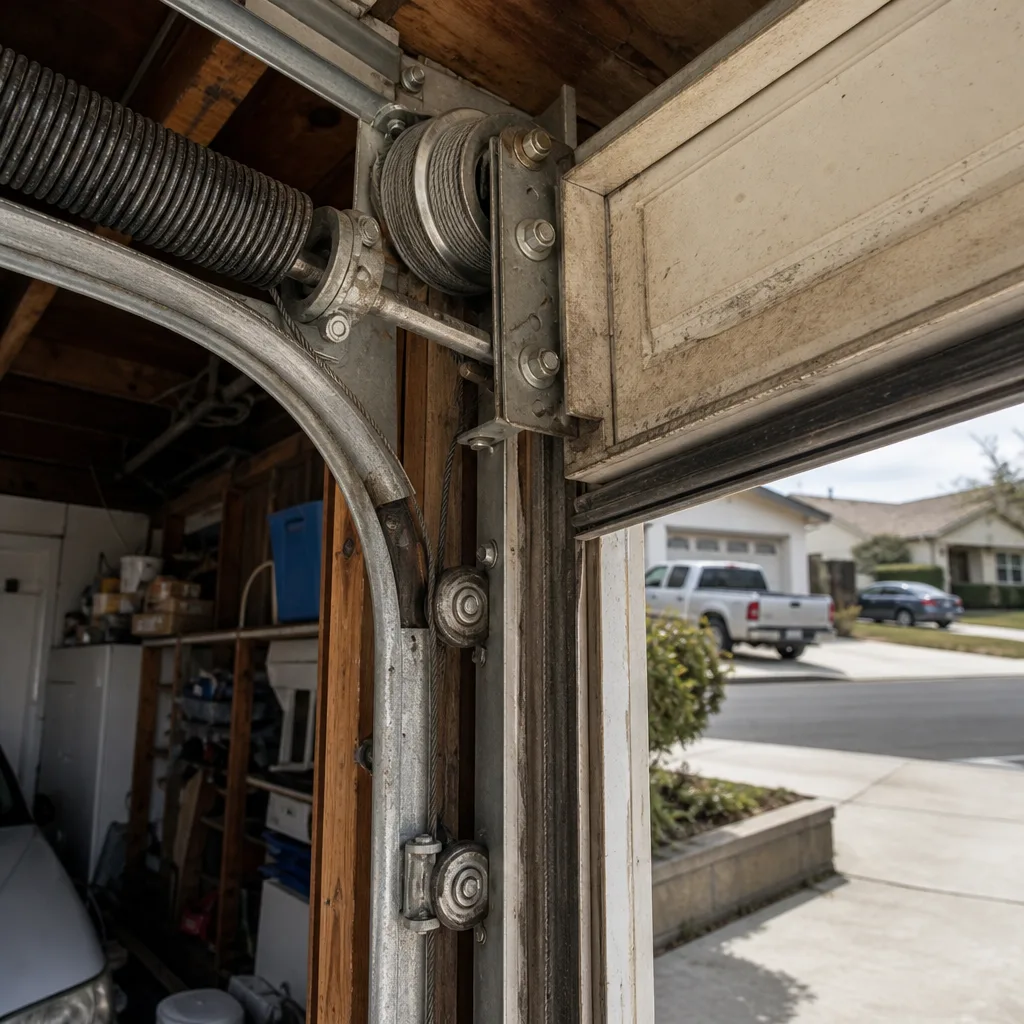
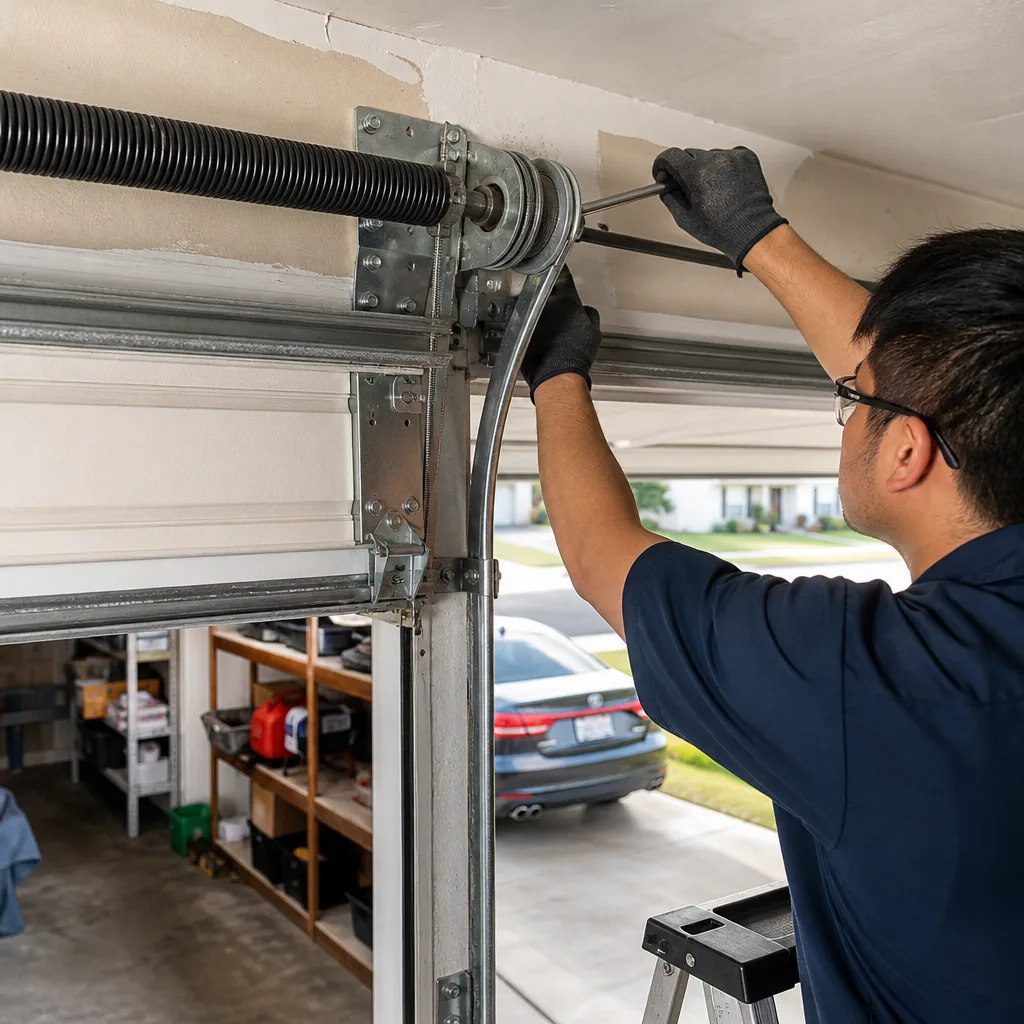
Stand inside the garage with the door closed and look up. The torsion spring is the tightly wound coil mounted horizontally above the door, usually on a shaft. A healthy spring is one continuous piece of metal. An unhealthy one shows separation in the coil. Any visible gap, even a quarter inch, means the spring has snapped. If you see two separate pieces, the spring is broken in two. Do not try to open the door. A broken torsion spring cannot be repaired, only replaced, and the replacement is a job for a professional with the right winding equipment. In our work on garage doors throughout Westminster, we replace torsion springs that have snapped on doors anywhere from five to fifteen years old. Spring life depends on cycle count more than age, but corrosion from coastal air, which we’ll cover below, shaves years off that lifespan.
Frayed Lift Cables
The cables run vertically along each side of the door, attached at the bottom corner brackets. Run a flashlight along the full length of both cables. You’re looking for what looks like split ends in a rope: individual wire strands poking out from the main bundle. Even one broken strand is a signal that the cable is fatiguing. A cable with significant fraying has a high probability of snapping under load, and a snapped cable can allow the door to drop with enough force to damage the track, the panels, or anything underneath it. Cables are cheap. The damage a snapped cable causes is not. If you see fraying, call for repair before using the door again.
Bent or Misaligned Track
The vertical tracks run up the sides of the opening and curve into horizontal tracks near the ceiling. Use your flashlight to check the alignment and the shape. A healthy track is straight, with no visible bends or kinks, and the roller sits fully inside the track channel at all points of travel. Signs of trouble include: a gap between the roller and the track, a shiny wear mark where the roller is rubbing against the track edge, or a visible bend where the door seems to catch as it moves through. A bent vertical track will eventually bind the door entirely. A bent horizontal track is less urgent because the door carries less weight there, but it still creates friction and wear.
Rusted or Worn Rollers
Check the rollers at the top and bottom of the door on both sides. Rollers are the wheels that ride inside the track. A healthy roller has an intact wheel surface, no flat spots, and no side-to-side play on its stem. A failing roller may show: visible wear on the wheel surface, a cracked or missing wheel, or a wobble when the door moves. Nylon rollers with worn bearings are the leading cause of grinding noise, which we covered in the sounds section above. Roller replacement is one of the most common repairs we make in Westminster, and it’s a repair that pays for itself in reduced door wear.
Gaps in Weatherstripping or Panel Seals
Finally, walk outside and look at the bottom of the door. The rubber weather seal along the bottom edge should sit flush against the garage floor all the way across. Over time, this seal cracks, compresses, or tears, and the result is a gap that lets water, rodents, and dirt into the garage. In Westminster, where winter rains are a fact of life, a failed bottom seal is a minor issue that creates major inconvenience. Panel joints can also separate or lose their seals, particularly on older wooden doors. Seals are a low-cost fix and usually a same-visit job when you’re already scheduling another repair.
Which Repairs You Can Safely Defer vs. Which Cause Secondary Damage
Budgets are real. Not every repair can be done the week it’s noticed. But deferred repairs are not equal. Some can wait months without consequence. Others create compounding damage that turns a $100 fix into a $600 problem. Here’s how to think about it.
Safe to Defer
These items can wait if the budget is tight, with the caveat that monitoring continues:
- Cosmetic panel dents and paint wear: Aesthetics only. No structural or safety impact.
- Weatherstripping replacement: Unless water intrusion is already happening, a worn seal can wait a few weeks.
- Faded or cracked paint on the door surface: Cosmetic. On steel doors, monitor for rust where paint has failed.
- Slight seasonal noise increase: If the door passes the release-cord test and the noise is not grinding, winter noise is a lubrication issue at most.
Not Safe to Defer: Repairs That Create Secondary Damage
These are the ones that escalate. Postponing them costs more than the original repair would have:
- A failing roller: A roller that’s seized or grinding is actively damaging the track. The track is an expensive component, and a scored track usually needs full replacement, not just roller replacement. The roller is $15 to $40. The track is $200 to $500 installed.
- A door that’s off balance: An unbalanced door forces the opener to work harder, shortening its life. It also wears the springs, cables, and rollers unevenly. A door that’s not balanced is an orchestra of future repairs waiting to happen.
- A sagging or misaligned track: A track that’s starting to bend will continue to bend as the door runs through it. The farther it bends, the more expensive the realignment or replacement becomes.
- A rusting spring: Corrosion is progressive. A lightly rusted spring will work until it doesn’t, but the failure, when it comes, is sudden. Replace a rusting spring on your schedule, not its schedule.
One more thing worth stating. If you defer a repair, we’ll tell you honestly whether it’s safe to do so. That’s the feedback Westminster homeowners tell us they appreciate most: a straight answer about urgency, not a pressure tactic. Call (833) 593-4519 and describe what you’re seeing. We’ll tell you which tier it falls into.
Opener-Specific Warning Signs in Westminster Homes
Garage door openers are the component most often misdiagnosed by homeowners. The motor works, so the door should open. When it doesn’t, the opener gets blamed. Or worse, the opener gets replaced when the actual problem is with the door. Here are the opener-specific symptoms that indicate the motorized side of your system is the problem.
Failure Patterns That Point to the Opener
- The door reverses before touching the floor, or closes and immediately reopens: This is a safety sensor problem. The photo-eye sensors at the bottom of the door track, the ones that know not to close on a child or pet, are misaligned, blocked, or failing. This is a fixable, often quick repair, not a replacement scenario. But it shouldn’t be bypassed. The sensors are a required safety device on every opener sold today, including LiftMaster, Chamberlain, Genie, and Craftsman models.
- The opener runs, the trolley moves, but the door doesn’t: This is usually a broken trolley connection or stripped gear inside the opener, depending on the model. Some openers have a plastic gear that strips at high cycle counts. Some have a coupling that disengages. Either way, the door is fine. The opener is not.
- The opener runs for a second and then stops, with no door movement: On a Raynor or LiftMaster opener, this often indicates an overload sensor tripping because the door is too heavy, which loops back to a spring problem. But it can also be a capacitor or motor winding failing in the opener itself. A release-cord test settles it in thirty seconds. If the door opens fine manually, the opener is the issue.
- The opener is loud but has always been loud: Chain-drive openers are inherently noisier than belt-drive openers. This is not a defect. It’s a design characteristic. Westminster homeowners replacing a chain-drive opener often choose a belt-drive for the noise difference if the garage is attached to a living space or bedroom.
- The opener responds intermittently or not at all to the remote or wall pad: This is a control system problem: remote programming, receiver board failure, or a wall-pad wiring issue. Not a door problem. In many cases, it’s a $15 to $60 fix, not a full opener replacement.
The takeaway: openers are simpler than doors, but they’re not interchangeable across brands. A LiftMaster logic board isn’t the same as a Craftsman logic board. A Genie force calibration differs from a Chamberlain calibration. It’s why we treat Garage Door Opener Repair in Westminster as its own dedicated service. Your opener, diagnosed correctly the first time, is the whole point.
How Westminster’s Climate Accelerates Certain Door Failures
Westminster’s garage door problems have a regional fingerprint. The coastal Orange County air moves inland, and by the time it reaches Westminster, it’s carrying enough salt and moisture to accelerate corrosion on any exposed metal. But it’s not the harshest coastal environment, so the damage is slow and often invisible until it’s advanced. Here’s what we see most often in Westminster garages, and why it matters.
Salt Air and Spring Corrosion
Torsion springs are made of high-carbon steel. They rust. In dry inland areas, that rust progresses slowly. In Westminster, the combination of marine air and the occasional marine layer means springs corrode faster than the national average. A spring that might last 15,000 cycles in Arizona lasts closer to 10,000 in Westminster, all else equal. When a spring rusts, the surface pits, and those pits become the stress points where the spring eventually cracks. We regularly replace springs in Westminster that show advanced corrosion at the ten-year mark, even on doors that haven’t been cycled heavily. The fix is straightforward: inspect springs annually, and replace them before they fail. A failed spring is a before-work emergency. A corroded-but-working spring is a scheduled repair.
Winter Moisture and Track Rust
Westminster gets rain, and rain follows cars into garages. A wet floor doesn’t directly rust tracks, but the constant humidity in an attached garage, especially one with a water heater or dryer, keeps the air damp. Track rust is the result, and track rust creates friction. Friction creates wear on rollers, and the cycle continues. We see more track wear complaints in Westminster garages that double as laundry rooms or workshops than in detached garages with good ventilation. The practical answer is a dehumidifier in attached enclosed garages, or at minimum, regular inspection of track surfaces for rust bloom.
Heat and Opener Electronics
Westminster summers don’t cook garage door opener electronics the way Palm Springs does, but an unconditioned garage in August still reaches 110°F on a hot day. Opener logic boards and capacitors are rated for temperature. Extended heat exposure shortens their lifespan. The symptom pattern is usually an opener that works fine in the morning and fails in the heat of the afternoon, or one that works weakly and then cuts out. If your Westminster opener is ten years old or older and starts misbehaving in summer, it’s worth getting the capacitor and logic board tested before you invest in more expensive repairs.
Common Mistakes to Avoid
- Lubricating the track instead of the rollers: The track is not a lubrication surface. Grease on the track collects dust and grit, which grinds the rollers faster. Lubricate the roller bearings, hinges, and spring. Leave the track clean and dry.
- Ignoring a noisy door because “it’s always done that”: A grinding door was not always doing that. It did not grind when it was new. The noise is the sound of a component failing. In Westminster, where garage doors are an everyday entry point, most homeowners use the garage door more often than their front door. A failing roller is a daily-use component that’s deteriorating.
- Replacing the opener when the door is the problem: An opener that won’t lift a heavy door is doing its job, not failing. Test the door manually before you spend money. A spring replacement is a fraction of an opener replacement, and an opener that fails under excessive load has a shorter life anyway.
- Replacing a spring with any spring that fits: Torsion springs are matched to the door’s weight, height, and cable drum. A mismatched spring creates a door that’s over- or under-counterbalanced, which wears every other component. Spring replacement requires a door-weight calculation, not a guess.
- Putting off a spring replacement because the door still opens: A tired spring is not a functional spring. A door that’s heavier than it should be is working your opener to death and stressing every hinge, cable, and roller. The spring repair is cheaper than the cascade of failures that follows.
- Bypassing safety sensors to make the door close: The sensors are not an inconvenience. They’re a regulatory requirement and a child-safety device. Bypassing them is dangerous and, in many Westminster HOAs and rental properties, a code violation. If the sensors are misaligned, fix the alignment. Don’t disable the function.
See the difference
 Before
 After
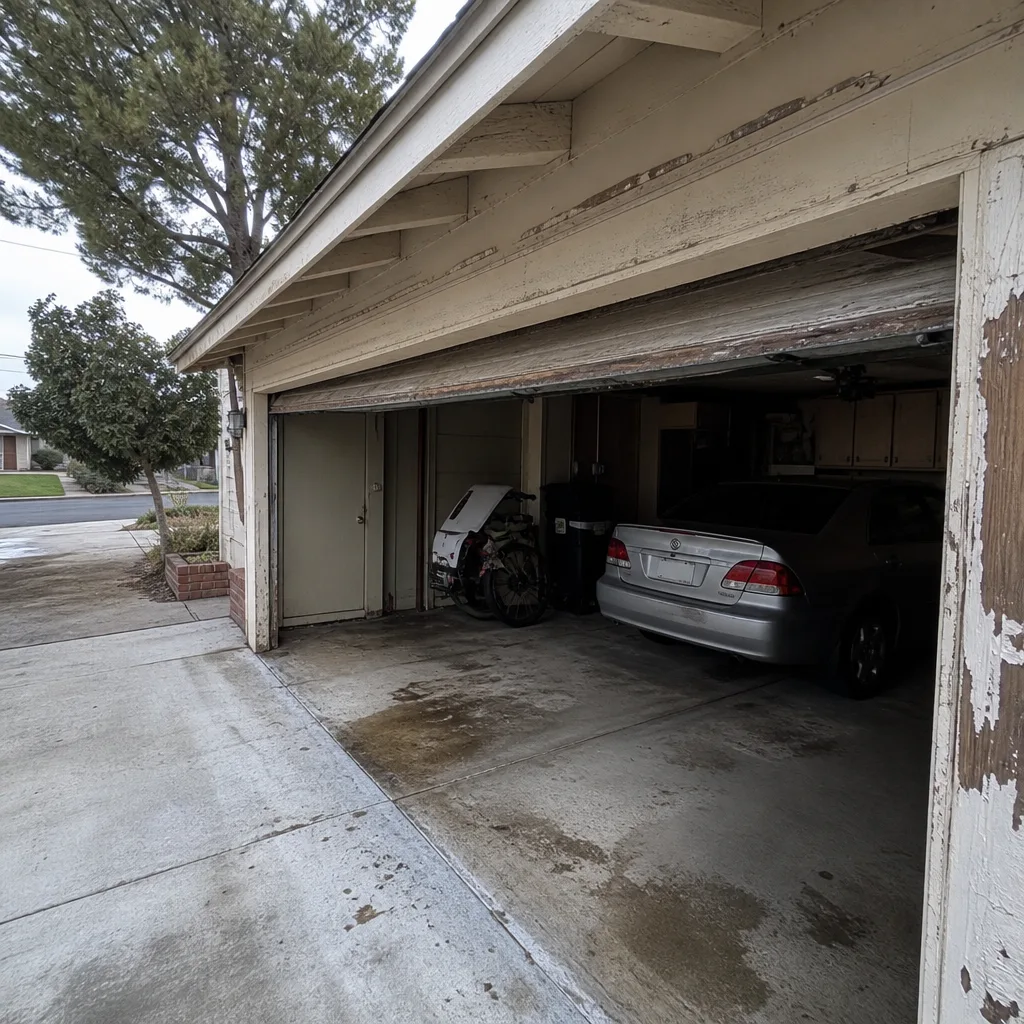 Before
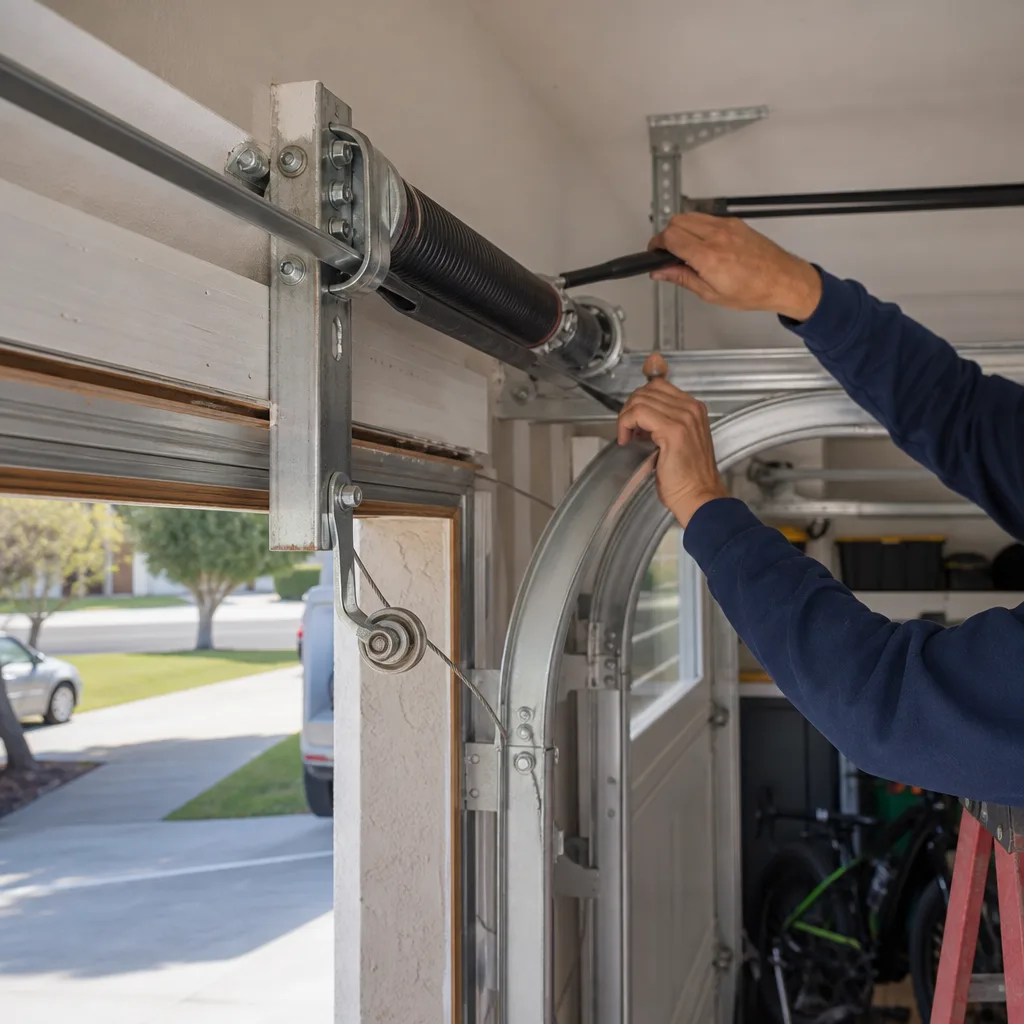 After
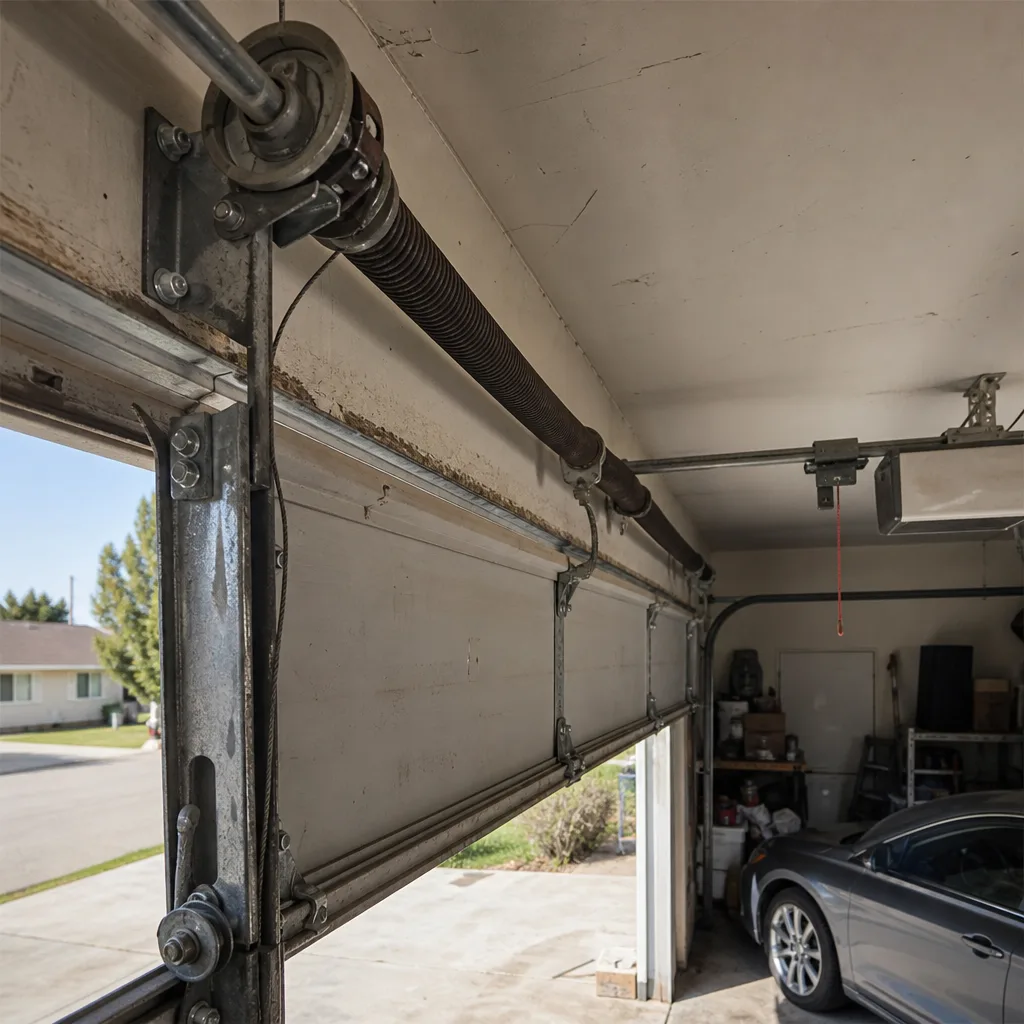 Before
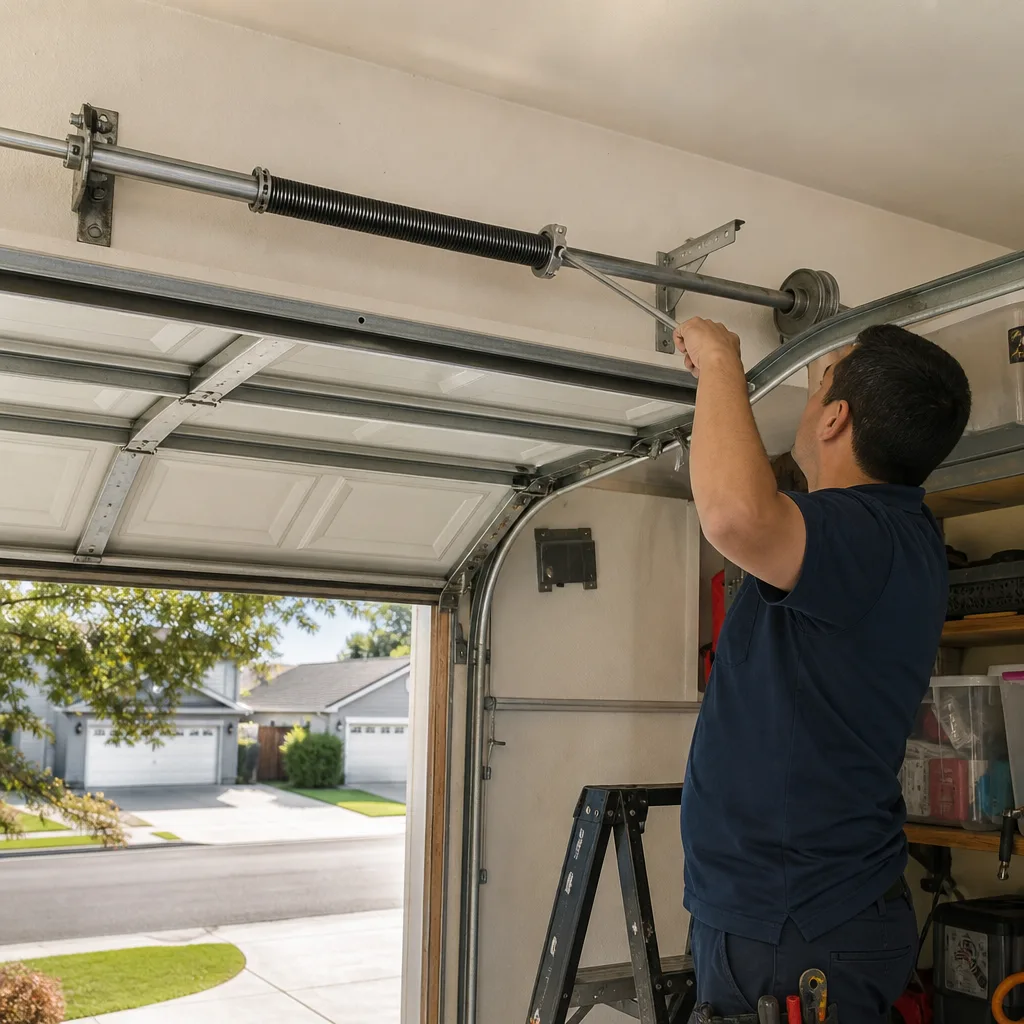 After
When to Call a Professional
You should call a professional the moment you observe any Tier 1 symptom: a cracked or separated spring, frayed cables, a door that drops when released, or a loud bang during operation. These are not DIY situations, and waiting on them risks injury and property damage. You should also call when you’ve done the basic checks we’ve outlined and the problem persists, or when you’re not confident you’ve identified the right issue. A five-minute phone call with a technician who works on garage doors all day, every day, will usually save you weeks of uncertainty and a few false starts. Redwood Garage Door Repair offers free estimates in Westminster. Call (833) 593-4519 and describe what you’re seeing. We’ll tell you what it likely is and what it costs before you commit to anything. The price is quoted and agreed before any work starts. No surprises on the invoice.
Frequently Asked Questions
Garage door spring replacement in Westminster typically costs between $180 and $340 for a single spring, or $260 to $500 for both springs, depending on the door’s weight and spring type. Most homes should replace both springs at once, since they have the same cycle count. Call (833) 593-4519 for an exact quote. Estimates are free.
Yes. A broken spring is a Tier 1 safety issue, and we treat it as a same-day priority whenever possible. Call (833) 593-4519 and tell us what you’re seeing. We’ll give you a straight answer on timing before you commit.
We service garage doors from the brands most commonly installed in Westminster and across North America, including Wayne Dalton, Raynor, Clopay, Amarr, and others. We work on the brand you already have, and we match parts to the actual door rather than retrofitting generic substitutes.
It depends on the door’s age, the condition of the panels, and the repair cost relative to replacement. As a general rule, if the door is under ten years old and structurally sound, repair is usually the better financial choice. If the door is over fifteen years old with panel damage and a failed spring, Garage Door Installation in Westminster may be the more cost-effective long-term option. We’ll tell you honestly which makes sense for your door and budget. Call (833) 593-4519 for a free evaluation.
That’s almost always a safety sensor issue. The photo-eye sensors at the base of the door track are misaligned, obstructed, or failing. On some LiftMaster and Craftsman models, it can also indicate force settings that have drifted out of calibration. It’s usually a repair, not a replacement. Call (833) 593-4519 and describe the symptom. We can often diagnose it over the phone before we arrive.
For Westminster homes, we recommend belt-drive openers from LiftMaster or Chamberlain for noise-sensitive garages, and chain-drive models for detached garages where noise doesn’t matter. Genie remains a solid budget option. The best opener is one matched to your door’s weight and your garage’s use pattern. If you’re replacing an opener, we’ll recommend a specific model for your door. Call (833) 593-4519 for an honest recommendation based on what’s already installed.
The Bottom Line
Your garage door is a system of components under constant tension, and it tells you when something’s wrong. The key is knowing how urgent each signal is. A cracked spring means stop now. A grinding roller means schedule within two weeks. A noisy winter door means buy some lubricant. The worst mistakes Westminster homeowners make are ignoring a failing spring because the door still opens, and replacing an opener when the real problem is an unbalanced door. If you can systematically sort symptoms into stop-now, schedule-soon, and watch-it tiers, you’ll never be surprised by a garage door failure again. For more guides & resources, browse our blog, and when you’re not sure, a free phone call to a garage door specialist beats three hours of YouTube guesswork. We’re here for that call: (833) 593-4519. Garage doors are all we do.
Written by the team at Redwood Garage Door Repair, serving Westminster.